

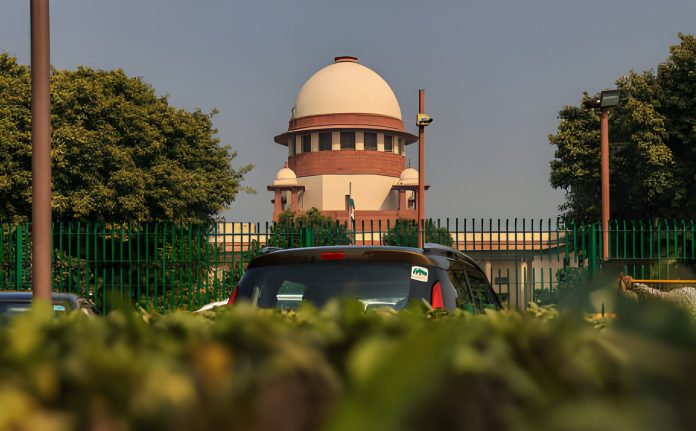
On Wednesday, the Supreme Court of India referred the matter of direct anticipatory bail applications to a three-judge bench, questioning whether litigants can approach high courts directly or must first seek relief from sessions courts.
A bench comprising Justices Vikram Nath and Sandeep Mehta deemed the issue significant enough to mandate a larger bench’s involvement, stating, “This matter requires to be heard by a three-judge bench.”
This initiative follows the Court’s appointment of senior advocate Siddharth Luthra as amicus curiae, tasked with providing assistance on the matter.
The Supreme Court had previously expressed serious concerns regarding what it termed the “regular practice” of the Kerala High Court to entertain anticipatory bail petitions directly. During a session on September 8, the bench questioned this anomalous practice, asking, “Why does the Kerala High Court regularly entertain anticipatory bail applications directly?”
The court referenced provisions from both the old Code of Criminal Procedure and the newly enacted Bharatiya Nagarik Suraksha Sanhita (BNSS), 2023, which outlines a hierarchical framework for filing bail applications. Specifically, Section 482 of the BNSS offers directives for granting bail to individuals who anticipate arrest.
The justices pointed out, “This does not happen in any other state. Only in the Kerala High Court do we see applications for anticipatory bail being regularly entertained directly.”
This judicial review arose in response to a plea filed by two individuals contesting a Kerala High Court order that denied their request for anticipatory bail. They had bypassed the sessions court process by going directly to the high court.
In its deliberations, the Supreme Court suggested this practice could potentially deprive courts of essential factual records, typically compiled in sessions courts. The bench stated, “We are inclined to consider whether the option to approach the high court is a matter of choice for the accused or whether it should be mandatory to first go to the sessions court.”
To further address the situation, the top court issued a notice requiring the Kerala High Court’s response through its Registrar General.
As discussions unfold, legal experts and practitioners await the clarity that this three-judge bench will provide regarding the procedural norms governing anticipatory bail applications in India.