

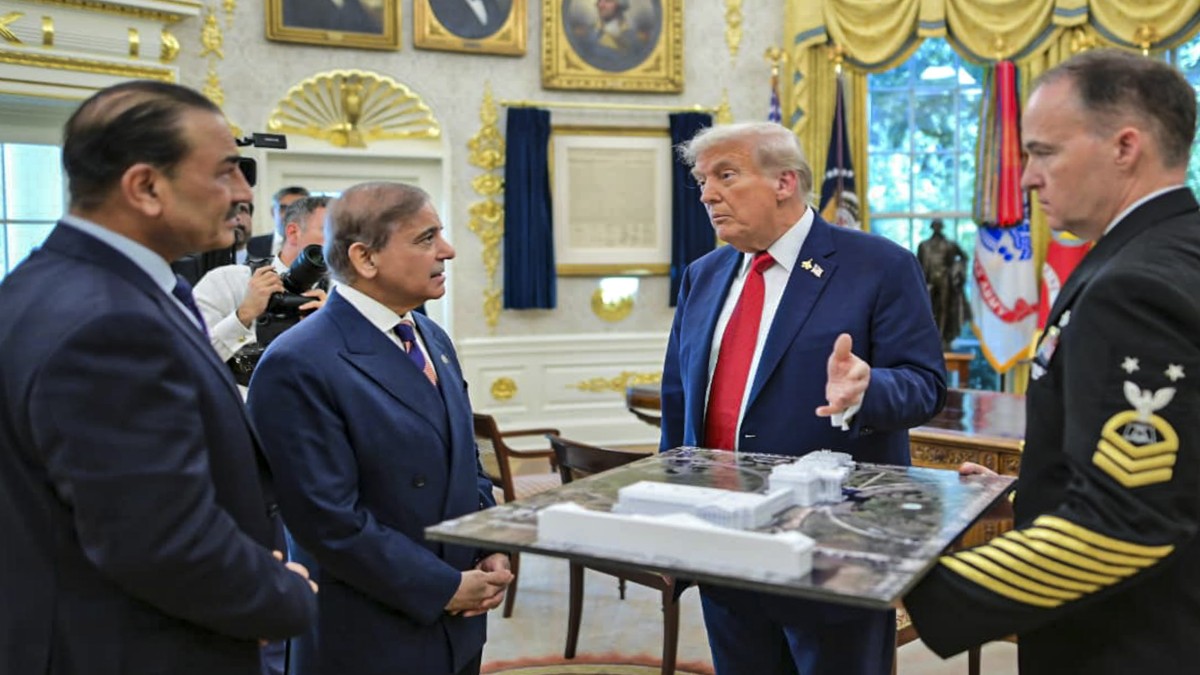
On September 30, US President Donald Trump declared that Pakistan Prime Minister Shehbaz Sharif and Field Marshal Asim Munir support his plan to end the Gaza conflict “100 per cent.” This announcement came during a joint press conference with Israeli Prime Minister Benjamin Netanyahu at the White House.
Trump stated, “This afternoon after extensive consultation with our friends and partners throughout the region, I’m formally releasing our principles for peace, which people have really liked.” He emphasized that the plan reflects contributions from various world leaders, thanking Arab and Muslim nations for their collaboration.
Among the leaders Trump mentioned during the press briefing were key figures from Saudi Arabia, Qatar, the UAE, and Jordan. He characterized these nations as “fully involved” in the negotiations, providing significant insights essential to the proposal’s development.
“The King of Jordan was with us in the United Nations. President Erdogan from Turkiye, along with leaders from Indonesia and others, contributed invaluable input,” Trump remarked. He underscored the importance of unity and cooperation in addressing the complexities of the Gaza situation, crediting PM Sharif and Field Marshal Munir for their early engagement.
In a dramatic statement, Trump disclosed that the Pakistani leaders had recently reaffirmed their backing for the peace proposal. He noted, “Just as I was walking out, they said, ‘Sir, you have a big notice from the prime minister of Pakistan and from the field marshal that they back this 100 per cent.”
Trump’s “Comprehensive Plan to End the Gaza Conflict” outlines a vision where Gaza transforms into a deradicalised zone, ensuring it poses no threat to neighboring countries and is set for redevelopment. The proposal stipulates that if both parties accept it, hostilities would cease immediately. Israeli troops would withdraw to defined lines, and military operations would halt during this transitional period.
The plan also calls for the return of all hostages within 72 hours of Israel’s agreement to the proposal, while Israel would reciprocate by releasing prisoners in a structured manner. Trump outlined a strategy for maintaining peace and security, emphasizing humanitarian efforts to rebuild Gaza.
In a united front, the foreign ministers from Saudi Arabia, Jordan, UAE, Indonesia, Pakistan, Türkiye, Qatar, and Egypt issued a joint statement applauding Trump’s leadership and efforts aimed at ending the conflict. They articulated their commitment to work with the US to achieve a resolution that prioritizes humanitarian aid to Gaza and respects the rights of the Palestinian people.
During the UN General Assembly session, Sharif met with Trump alongside Munir, reinforcing diplomatic ties between Pakistan and the US. Earlier this summer, the leaders engaged informally during a lunch hosted by Trump, which showcased their willingness to cooperate.
Sharif, who attended the high-level UN meeting, discussed ongoing efforts to curtail the violence and prevent dislocation of the Palestinian people. The Pakistani leaders’ participation signifies a strategic alignment amongst nations looking to stabilize the region.
As the international community watches closely, Trump’s plan faces the challenge of implementation amidst ongoing tensions. However, the collective backing from influential nations like Pakistan may provide a critical boost toward fostering long-term peace in Gaza.